Rope vs straight bar vs D-handle on a cable machine
Buy the D-handles first. A rope and a straight bar each do one job the other cannot, but a pair of handles is the only attachment that changes what you can train rather than how it feels.
What decides it: Whether your hands are locked to each other, locked apart, or free.
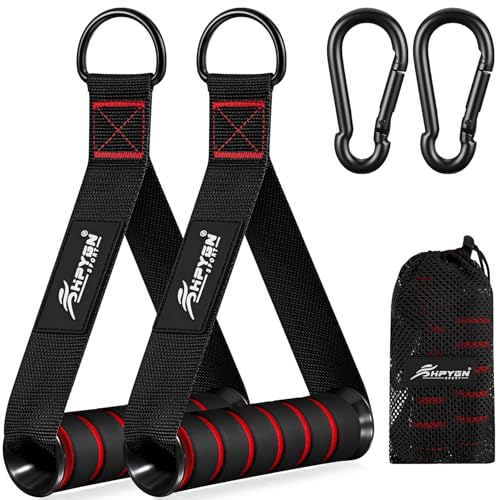
D-handle
Pick this if you want one attachment that covers rows, pushdowns, curls, flyes and face pulls, one arm at a time.
Tricep rope
Pick this if your hands need to travel apart at the bottom of a pushdown, or you want a neutral grip that is not fixed.
No pick here yet. The specs below are the type, not a product.
Straight bar
Pick this if you want both hands locked at a fixed width, and you have the room to swing 48 inches of steel.
No pick here yet. The specs below are the type, not a product.
| D-handle | Tricep rope | Straight bar | |
|---|---|---|---|
| Grip | Fixed, does not rotate | Free, each hand independent | Fixed width, both hands |
| Attaches by | Carabiner, included | Carabiner, usually included | Carabiner, usually included |
| Material | Braided nylon webbing, triple stitched | Nylon rope, rubber end caps | Knurled steel |
| Load rating | 260 kg, manufacturer static rating | Not published by major makers | Not published by major makers |
| Own weight | Not published | Under 1 lb | About 15 lb |
| Sold as | Pair, with a mesh carry bag | Single | Single |
| Fits | Cable crossover, pulley, Smith machine, reformer, chair gym | Any carabiner clip | Any carabiner clip, with clearance |
Your cable machine came with one attachment and it is almost certainly the wrong one to keep using.
The rope vs straight bar question is where most people start, and it is the wrong question. Those two are variations on a theme. The third option is a different instrument.
Here is the theme. Every one of these clips to the same carabiner, so whether you own a crossover, a functional trainer or one low pulley bolted to a rack, compatibility is not the decision. What separates them is what your hands are allowed to do.
Rope vs straight bar, the only difference that matters
A straight bar locks your hands to each other at a fixed distance. A rope lets them separate. That is the entire difference, and everything people argue about downstream follows from it.
On a pushdown, the bar keeps your forearms in one plane and your wrists in one position for the whole rep. Some people find that stable and some find it grinding, and which one you are is not something a page can tell you. The rope lets your hands split apart at the bottom, which lets the wrist rotate into whatever position it wants and adds a few degrees of travel at the end of the movement.
That is genuinely useful and it is also oversold. The extra travel happens in the part of the range where the triceps have the least mechanical disadvantage left to overcome. It feels like more work. Whether it produces more is a question we have not seen settled anywhere worth citing.
Rogue publishes the numbers for both, which most sellers do not, so they make a decent reference for what a well-made example looks like. Their tricep rope is 28 inches of nylon end to end, about 11.5 inches a side once it is doubled through the clip, with rubber ends and plastic bushings. Their lat bar is 48 inches of knurled carbon steel at 1.125 inches thick.
What a D-handle does that neither of them can
It lets you train one arm at a time.
That sounds small and it is the whole argument. A bar and a rope both commit both hands to the same rep. A pair of handles gives you single-arm rows, single-arm pushdowns, cable curls with a free wrist path, standing flyes, and face pulls with your hands genuinely independent. If one side of your back is doing more of the work than the other, a bar hides it and a handle exposes it.
There is a catch worth knowing before you buy, and it splits the category in a way the listings rarely make clear. Some D-handles spin and some do not. Rogue's aluminum single handle uses a shoulder bolt so the grip spins freely through the rep. The nylon-strap handles that dominate the marketplace, the HPYGN pair included, are fixed. On high-rep pushdowns some people find a fixed grip fights the wrist. If that is you, you want a rotating handle and you will not find one for marketplace money.
The 15 pounds nobody mentions
A lat bar is a heavy steel object. Rogue's weighs 15.6 pounds.
That is not a criticism, it is arithmetic. Every rep on a straight bar starts with 15 pounds already hanging on the cable before you touch the pin, which matters if your stack starts at 10 pound increments and you are training an isolation movement. It also has to live somewhere. Forty-eight inches of steel does not go in a drawer, and on a wall-mounted setup in a spare room it is the attachment that ends up leaning against something.
A rope weighs under a pound. A pair of handles weighs less and packs flat.
Load ratings are a segment tell, not a strength tell
Marketplace listings publish a load rating and Rogue does not. It is tempting to read that as the cheap product proving itself and the expensive one being coy. It is the other way around.
A number like 260 kg on a strap is the manufacturer's own static figure for the webbing, not a certified working load, and not a claim about the carabiner, the cable or the pin on your stack. Nobody audits it. The brands that print it are the brands competing on a listing page where a number wins the scroll, and the brands that leave it off are selling into a market that would ask what standard it was tested to. Neither tells you much about whether the stitching survives two years.
Treat a published rating as evidence the strap was built with margin, and as nothing else. For a home lifter on a stack that tops out around 90 kg, every competently made attachment in this comparison clears the bar by a distance you will never test.
Buy in this order
Handles, then whichever of the other two matches a movement you actually do.
A pair of D-handles is the only one of the three that adds exercises rather than changing the feel of exercises you already have, which is why it goes first even though it is the least exciting purchase. The rest of the cable attachment picks follow the same logic, and so does the honest version of this answer: if the handles on your machine are intact and not slipping, none of this is urgent.
Then the rope, if you do pushdowns and your wrists have opinions. The bar last, and only if you have the floor space, because it is the one that costs you storage and 15 pounds of stack range in exchange for a grip position you can approximate with the other two.
None of these have been through our hands. Everything above is read off published specifications and the mechanics of what clips to what, and the specifications are linked so you can check them. What a page cannot tell you is how a fixed grip feels on your wrist at rep twelve, and that is the thing most likely to decide which of these you keep using.