Jackery Explorer 1000 v2 Review: 910Wh of a Rated 1070
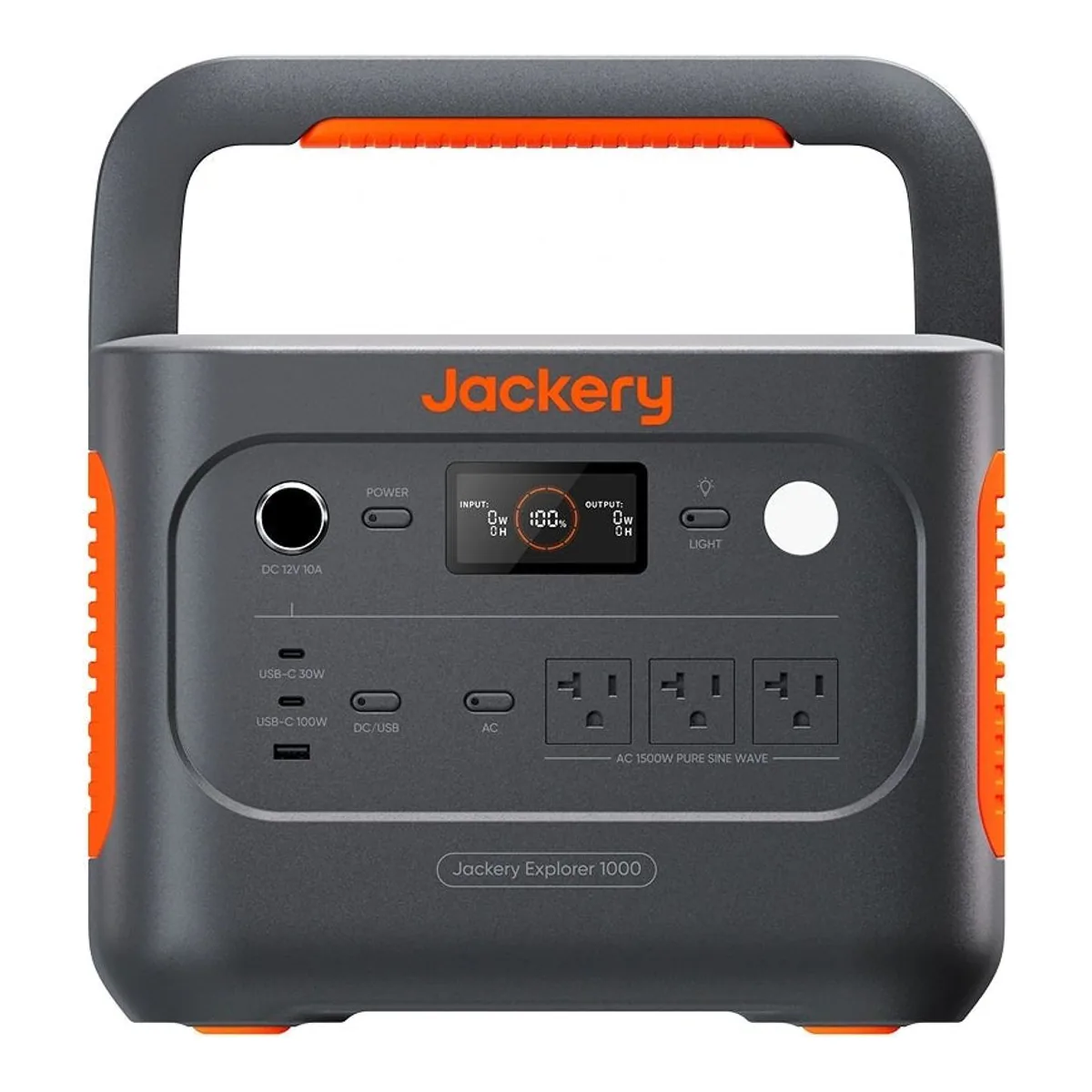
Both numbers that matter, delivered capacity and recharge time, land close to what Jackery claims, which is more than this category usually manages. The 1500W ceiling is the real limit and it decides whether your refrigerator starts.
- 1500W continuous output, 3000W peak surge
- Recharges 0 to 100% in 1.7 hours via a standard AC wall outlet
- LiFePO4 battery rated for 4000 cycles to 70%+ capacity
- 400W max solar input
Two independent labs have put a meter on the Jackery Explorer 1000 v2 and come back with nearly the same answer. About 910 of the 1,070 watt-hours on the spec sheet make it back out through the outlets, which OutdoorGearLab scored as 85 percent efficiency. The Solar Lab, running a separate test at a 1,479W draw, measured 87.5 percent.
That is a good result, not a scandal. Every battery loses a slice of its rated capacity to the inverter converting DC to household AC, and losing 12.5 to 15 percent of it is normal to slightly better than normal. The reason to lead with the figure is that 910Wh is the number to do your runtime arithmetic with, and it is not a number Jackery publishes.
We have not had one of these on a bench. Everything below is read off Jackery's own published specification, the live Amazon listing for this exact ASIN, and two independent benches that metered it and published what came out, which is what the badge at the top of this page is claiming and what how we pick sets out.
What the Jackery Explorer 1000 v2 actually delivers
Divide 910 by whatever you are plugging in. A 150W load, meaning a couple of LED lights, a phone, a laptop and a fan, runs about six hours. A 60W CPAP runs most of two nights. A 1,000W microwave gets you somewhere under an hour of actual cooking, which sounds bad until you remember nobody microwaves for an hour.
Near the top of its range the shortfall is real. In the Solar Lab test the unit held a 1,479W draw for 37.5 minutes where the rated capacity predicted 43, so plan a heavy load off the measured figure rather than the rating.
| Rated | Measured | Source | |
|---|---|---|---|
| Capacity delivered | 1070Wh | 910Wh | OutdoorGearLab |
| Full AC recharge | 1.7 hours | 1.58 hours | OutdoorGearLab |
| Weight | 24 lbs | 24.4 lbs | OutdoorGearLab |
| Sustained AC load | 1500W | 1560W held 10 min | The Solar Lab |
Three sources weighed it and landed at 23.8, 24 and 24.4 lbs. It is a 24 pound box, and it carries better than that suggests because the mass sits low.
Will it start your refrigerator?
Usually, and the exception is specific enough to check before you buy. An Android Police reviewer running the Explorer 1000 v2 through a seven day outage could not get an older refrigerator to spin up at all. Metering it with an EcoFlow Delta 2 showed why: the compressor pulled 1,700W for slightly longer than the Jackery's surge window allows, so the unit refused rather than started. A newer refrigerator on the same test ran fine, and a Bodega car fridge ran more than a day per charge.
So read the 3,000W peak rating as a very short window rather than headroom. The Solar Lab held 1,560W for a full ten minutes without complaint, which is the useful finding, then watched it accept 2,200W for a couple of seconds before shutting down. Continuous output is 1,500W and that is the honest ceiling. Peak covers the instant a motor kicks over, not a second and a half of a tired compressor fighting its start capacitor.
Anything with a motor or a heating element is where this matters. Anything with a power brick will never come close.
The recharge beats the claim, and then the catch
Jackery quotes 1.7 hours from empty. OutdoorGearLab clocked 1.58 and the Solar Lab clocked one hour and 35 minutes, so the real unit is slightly quicker than the marketing, which almost never happens in this category. Emergency charge mode, which Jackery advertises as a one hour top-up, measured just under that.
Here is the part no spec sheet covers. Pass-through charging collapses under load. With roughly 100W running the unit accepts near its full input, but at a 1,400W draw the Solar Lab found the incoming charge dropped to almost nothing. Refilling and running a heavy appliance are not things it does at the same time, which changes how you sequence an outage: charge it hard while the grid is up, not while the space heater is on it.
OutdoorGearLab still marked the charging speed down, at 6.8 out of 10, because several rivals in this capacity class now do the whole job inside an hour. Fast is relative and this category moved.
Solar is the part that got smaller
400W solar input is the ceiling, split across two DC ports rated 12 to 16V at 8A and 16 to 60V at 10.5A. The Solar Lab measured a full solar recharge in about 4.5 hours with that input available; OutdoorGearLab estimates three to four under ideal sun and docks the unit for it. The EcoFlow Delta 3 Classic on the same shelf takes 500W, so the ceiling is low for the class without being unusual in it.
The input is a barrel connector rather than the MC4 plug most panels terminate in, so a third-party array needs an adapter cable, and Jackery does not guarantee behavior with panels it did not sell. Adapter cables specifically listing this model are easy to find.
Budget for one if you already own panels, and budget for the panel itself either way, because nothing in this category ships with one.
Three outlets, a sealed battery, and near silence
Three AC outlets is the port count, alongside an 18W USB-A, a 30W USB-C, a 100W USB-C and a 12V 10A car socket. OutdoorGearLab called the AC spacing tight, which is the standard complaint about a small chassis: a fat wall wart on the middle outlet costs you a neighbor.
It is quiet. Both tests describe it as near silent even close to maximum draw, which as a power station for camping is the difference between one you can sleep next to in a camper and one you cannot.
It runs a LiFePO4 battery rated for 4,000 cycles to 70 percent or better, which at a charge a day is roughly eleven years. Charge it weekly and the cycle count stops being what kills it, because calendar aging gets there first. It is also sealed. There is no expansion pack for this model and none coming, so the capacity you buy is the capacity you own, and the warranty behind it is three years against the unconditional five Anker puts on its comparable unit. EcoFlow's five is three plus two more for registering the app, so unregistered it matches the Jackery. Charging works between 32 and 113F and discharging between 14 and 113F, so a cold garage in January is inside the discharge range and outside the charge one.
What we would buy instead
If the 1,500W ceiling is what worries you, more capacity is not the fix. The Anker SOLIX S2000 holds nearly twice the watt-hours and stops at the same 1,500W. The unit that raises the ceiling is the EcoFlow Delta 3 Classic, same size class, 1,800W continuous. If weight is the objection, the answer is smaller and lighter, not cleverer. All of them sit in the four power stations we compared with their measured numbers next to this one. If nothing on that page fits, the gap is usually 240V. No unit in this class supplies it, and a well pump, a dryer or central HVAC needs it, which pushes you out of portable power stations entirely and into a transfer switch and a generator.
What it will and will not run
Electronics are a solved problem here. A laptop, a router, a phone, a CPAP without a heated humidifier and a string of lights all draw so little that runtime is the only question and 910Wh answers it generously.
Motors and heat are where the ceiling bites. A modern refrigerator, a box fan, a blender and a coffee maker are fine. A full-size window air conditioner, a space heater on high, a table saw and an older refrigerator with a hard-start compressor are all live risks against 1,500W continuous, and the failure is usually a refusal to start rather than anything dramatic. Check the nameplate on the appliance, not the box on the power station, and the whole question resolves before you buy either one.
Everything else we have verified in this category sits on the power station shelf as the reviews get written.
Made up your mind?