Jackery HomePower 3600 Plus Review: 3584Wh, 120V Only
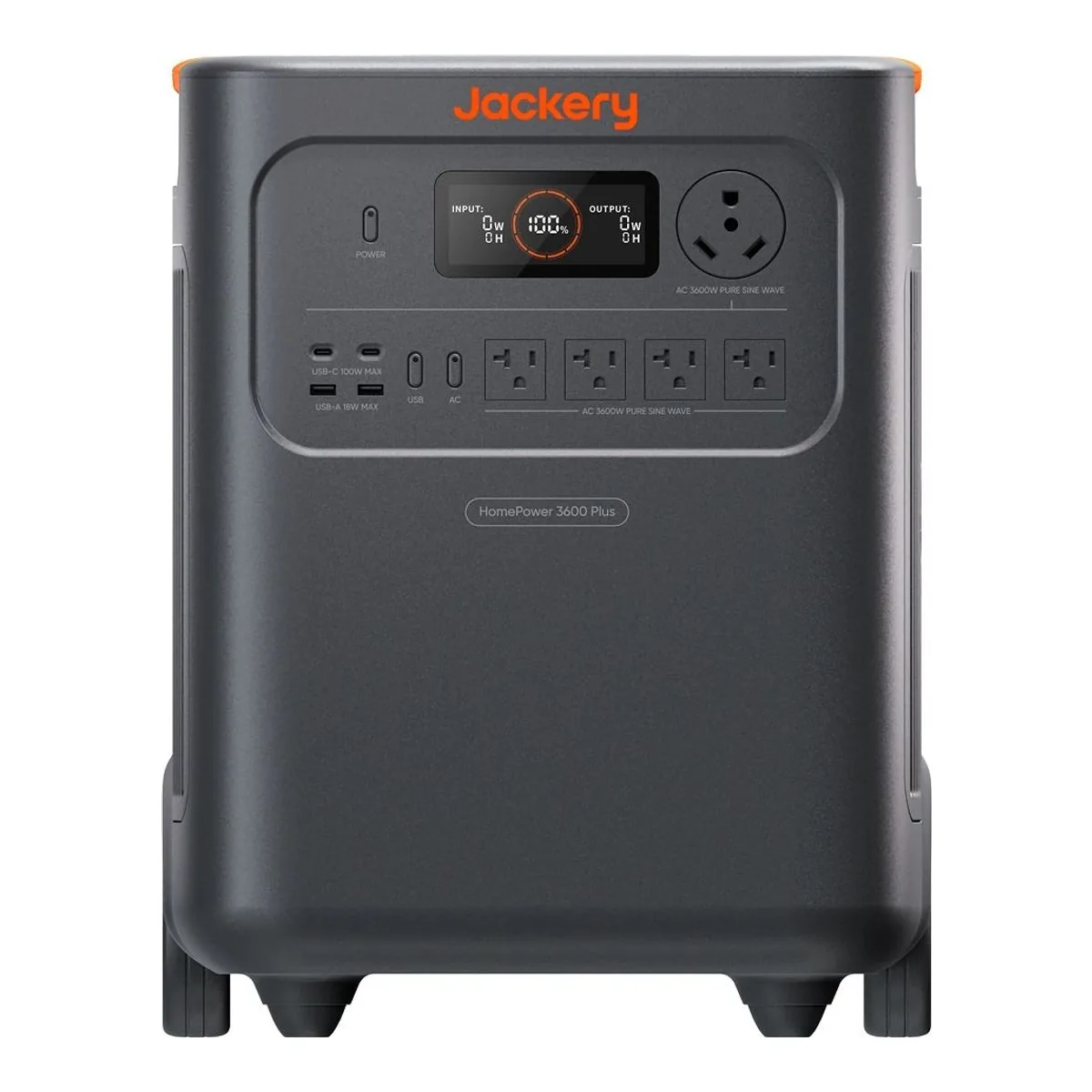
A large, quick, well warrantied battery that runs the 120V half of your house and cannot touch the other half. The 34W it burns doing nothing is the number nobody puts on the box.
- 3600W continuous AC output, 7200W surge peak
- 3584Wh LiFePO4, expandable to 21kWh with add-on battery packs
- 1800W maximum AC input, 1000W maximum solar across two DC8020 ports
- Four 120V AC outlets plus a TT-30 30A RV outlet
- 6000 cycles to 70%+ capacity, 5-year warranty
- 120V only. Split phase 240V needs a second unit and Jackery's 240V hub
It is 120V. Everything else about the Jackery HomePower 3600 Plus follows from that one line on the spec sheet, because 120V is what your lights, your refrigerator and your furnace blower want, and it is not what a well pump, an electric dryer or central air conditioning wants. Settle that before you read another number.
What the rest of the sheet buys is a genuinely large battery in a box you can wheel. As a home backup power station it carries 3584Wh, 3600W continuous with a 7200W surge, four household outlets and a TT-30 RV socket across the front, and cells Jackery rates at 6000 cycles to 70 percent or better behind a five year warranty. That warranty runs two years longer than the one on the Explorer 1000 v2, which is the clearest signal available of which tier this unit thinks it belongs to.
Every figure below comes off Jackery's own published specification, the live listing for this exact ASIN, and two independent benches that put meters on the unit: The Solar Lab and SolarGenReview. Where their measurements and Jackery's claims disagree, and on idle draw and solar recharge they disagree sharply, the meters win and the page says by how much.
Where the 3584Wh actually goes
The Solar Lab metered the inverter at 89 percent, so about 3,190Wh of the 3,584 printed on the case reaches the outlets, and that is the number to do your arithmetic with.
A modern refrigerator averaging 60W across its duty cycle lives on that for a little over two days. A gas furnace whose blower and controls draw 400W while running gets you through a long cold night with room left over. A 1,500W space heater eats the whole thing in two hours, which is the honest way to say that resistive heat and batteries do not get along.
Surge behavior is the pleasant surprise. Testers pushed 5,900W through it repeatedly without tripping the inverter, well inside the 7,200W rating and far enough above the 3,600W continuous figure to cover a compressor kicking over. The smaller Explorer refused an older refrigerator for exactly that reason. This one has headroom that unit did not.
Expansion is where the marketing and the measurement part company. Jackery says a fully expanded unit runs a fridge for nearly two weeks. The Solar Lab's own testing landed closer to 9.5 days. Both are a long time, and the gap is worth knowing about, because 9.5 days is the number that came off a meter.
The Jackery HomePower 3600 Plus is 120V, and that is the whole decision
There is no such thing as a single-box 240V power station in this lineup. Split phase 240V takes a second unit and Jackery's 240V hub, and no setting, adapter or firmware update gets one station to produce it on its own.
So walk your panel before you buy. Anything on a double-pole breaker is 240V: the well pump, the electric range, the dryer, the water heater, central air. If the thing you are actually trying to keep alive sits on one of those, a single HomePower 3600 Plus is the wrong purchase no matter how large the battery is.
Everything on a single-pole breaker is fair game, and for most houses that is the refrigerator, the freezer, the lights, the internet, the furnace blower and every outlet in the place. That covers a lot of an outage. It does not cover a house on a well.
A manual transfer switch that feeds a subpanel rather than a spread of extension cords is a separate purchase, while the TT-30 socket on the front is the same 30A connector an RV shore power cable already uses, so a trailer plugs straight in with nothing bought at all.
Buy it big or expand it later
Base capacity is 3584Wh and the ceiling with add-on packs is 21kWh, which is a six-fold difference and the reason this model exists in the lineup at all. The top of that range is whole home battery backup territory; the bottom of it is a large portable. A dedicated DC expansion port rated to 100A is what carries that, alongside an AC expansion port rated to 7200W.
Here is where we have to be careful with somebody else's arithmetic. Jackery and the Amazon listing both say 21kWh. One dealer spec table says five add-on packs, The Solar Lab says six and quotes 21.5kWh. Those cannot all be right, so the only number on this page is the total both primary sources agree on. If the pack count matters to your plan, count it in the cart before you commit to a staged purchase.
What the expansion buys is measured rather than modeled: 9.5 days of refrigerator on a fully expanded unit, on The Solar Lab's meter. Set against a base station that runs the same fridge a little over two days, that is the whole argument for starting with the expandable model even if you only buy the one box this year.
It costs 34W just to sit there ready
This is the figure nobody prints on a box. Idle consumption came in at about 34W on The Solar Lab's meter, inverter running and nothing drawing from it.
Do the division and a full charge empties itself in roughly four and a half days of doing absolutely nothing.
That reframes how you own one. A station kept plugged in and topped up is fine, because the wall makes up the difference. A station charged to full and parked in the garage for hurricane season is not fine, and the failure is quiet: you go out to a unit you charged in June, find it flat in July, and nothing about it looks broken.
Jackery publishes no standby draw with AC output switched off, and none of the tests we read measured one, so we are not going to guess how much lower it gets. What is measured is 34W with the inverter live. In practice that means leaving it on the charger, or checking it monthly.
Fast from the wall, slow from the sun
AC input tops out at 1800W and The Solar Lab clocked a full recharge in about 2.5 hours. For a battery this size that is quick, and it is the mode you will actually use, since a grid outage almost always ends before the next one starts.
Solar is the compromise. The ceiling is 1000W across two DC8020 barrel ports, which on a station of this capacity is thin. Four hours came off The Solar Lab's clock from a 1000W array in clear conditions. SolarGenReview, testing in sun that was not perfectly angled under a sky that was not perfectly clear, needed over eight hours for the same job.
Take the second number as your planning figure. Panel output falls off a cliff with angle and haze, and the four hour claim assumes neither.
Pass-through charging holds up better here than on the smaller Jackery. UPS mode carried loads to 1400W while the unit was charging, so a modest household draw and a refill happen at the same time, which is not something every station in this class manages.
The handle, the stairs and the light that is not there
It weighs 77 lbs. Wheels and a telescoping handle make that manageable across a garage floor and irrelevant on a staircase, and SolarGenReview says plainly that most people will not carry it up one. Decide where it lives before it arrives. The Solar Lab also flags the handle mechanism as flimsy, with a habit of sliding back in on its own while you are pulling. Minor, and annoying in the exact situation the product exists for.
There is no built-in light, a small omission that registers only because every competitor includes one.
Fan noise peaked at 48 dB from three feet in SolarGenReview's testing, quieter than a window air conditioner and audible in a bedroom. Jackery markets a 30 dB quiet mode. Nobody we read put a meter on that claim, so we are not repeating it as a measurement.
How to store it between outages
The battery charges between minus 4F and 113F and discharges between minus 4F and 131F, so an unheated garage through a northern winter stays inside both windows. That is a wider charge range than most stations in this class publish, and it is the difference between a unit you can keep where it is convenient and one you cannot. Cycle life will not be what retires it either. At 6000 cycles to 70 percent, a charge a week is more than a century of service and a charge every single day is over sixteen years. That is the quiet argument for buying a LiFePO4 power station over the lithium-ion chemistry this category used to ship.
The maintenance that actually matters is the one the 34W creates. Pick a schedule, put it on a calendar, and treat a stored battery as something that needs checking rather than something that waits. A generator sitting in the same garage burns nothing at all, which is the real advantage of the machine on the other side of that comparison between home battery backup and a generator.
Where this unit lands against the smaller stations, and what to buy instead if 3584Wh is more than you need, is laid out across the four power stations we compared.
Made up your mind?