AV Receiver vs Amplifier for Home Theater or Stereo
Buy the AV receiver if a television, a games console or a streaming box is in the system, because an amplifier has no HDMI input and cannot decode a surround track at all. Buy the integrated amplifier if the sources are two speakers, a turntable and music, where the receiver's entire video half is a fan and a menu you will never open.
What decides it: Whether anything you own connects over HDMI.
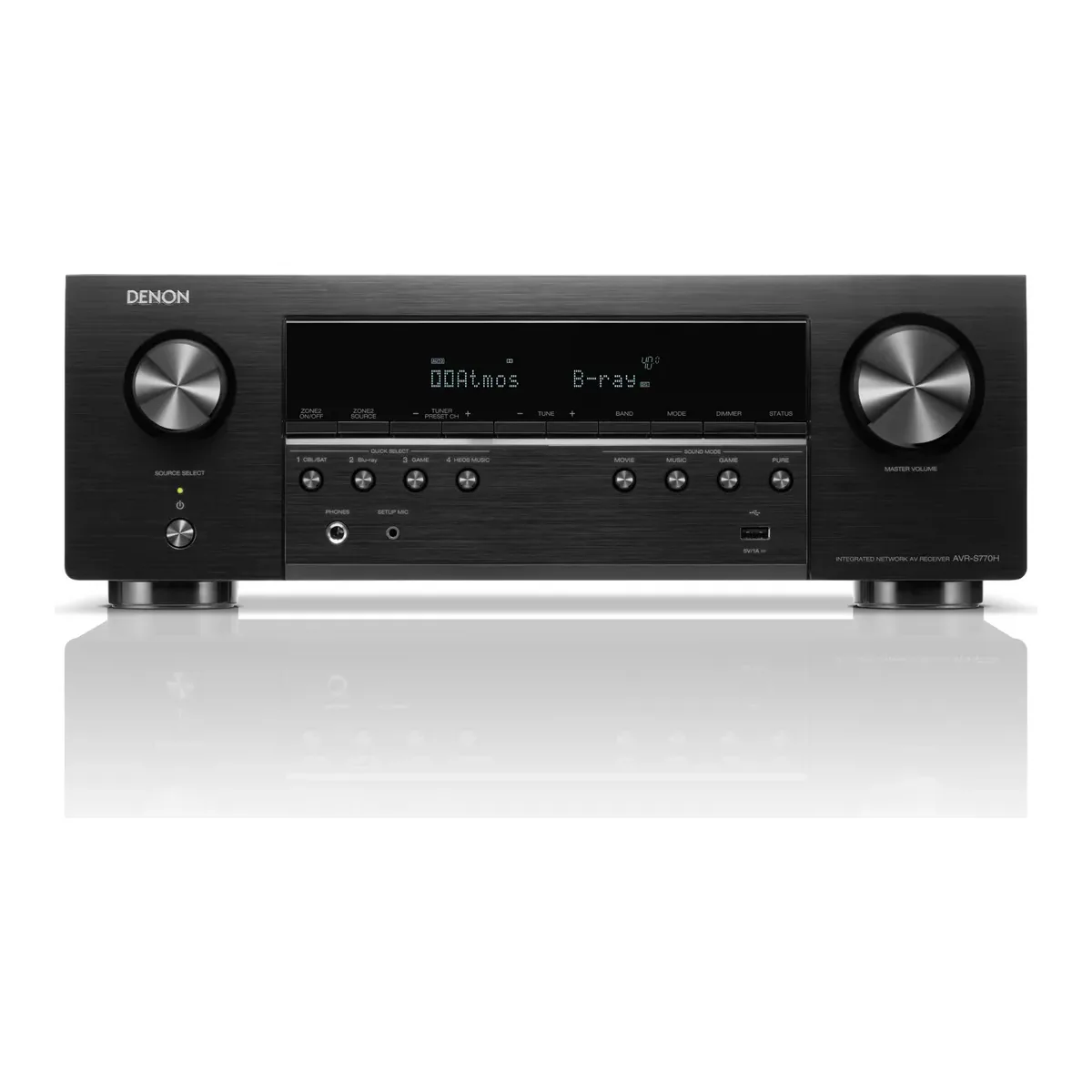
AV receiver
Pick this if a television, a console or a streaming box is in the chain, you want more than two speakers, and you want one box switching the picture as well as the sound.
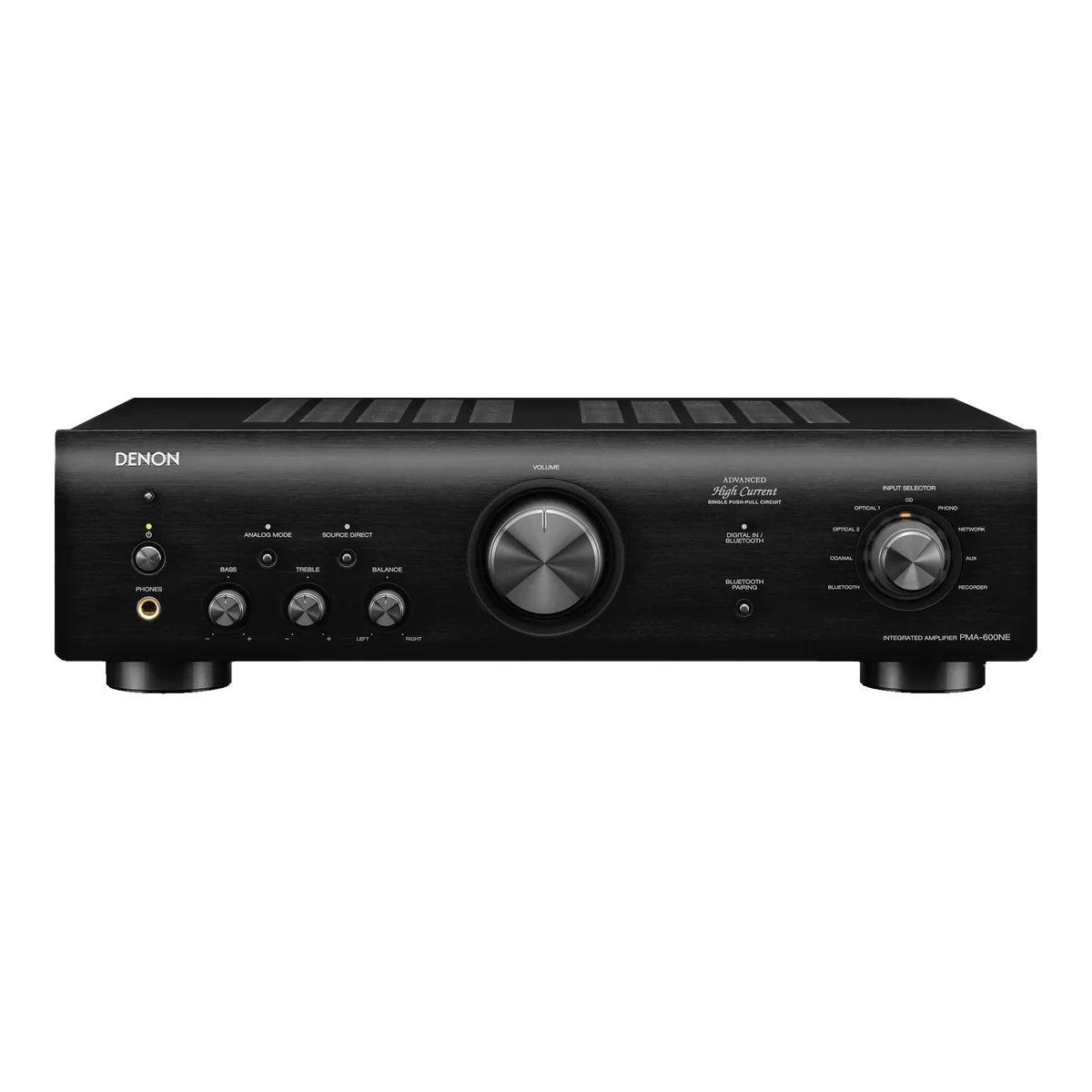
Integrated amplifier
Pick this if it is two speakers and music, you have a turntable or a CD player, and the only part of a receiver you ever wanted was the part driving the speakers.

Stereo receiver
Pick this if you want the amplifier and you also want FM radio, and you are willing to give up every digital input to get it.
| AV receiver | Integrated amplifier | Stereo receiver | |
|---|---|---|---|
| Channels | 7.2, Atmos to 5.1.2 | 2.0 | 2.0 |
| Power per channel | 75W (8 ohm, 20Hz-20kHz, 0.08% THD, 2ch driven) | 45W (8 ohm, 20Hz-20kHz, 0.07% THD) | 90W (8 ohm, 20Hz-20kHz, 0.09% THD) |
| HDMI in/out | 6 in, 1 out | None | None |
| 8K inputs | HDMI 4, 5 and 6 | None | None |
| Atmos / DTS:X | Dolby Atmos and DTS:X | Neither | Neither |
| TV audio return | eARC on the output | None, optical in only | None, no digital input |
| Network | HEOS, Wi-Fi, AirPlay 2 | Bluetooth only | Bluetooth only |
| Phono | Yes, moving magnet | Yes, moving magnet | Yes, moving magnet |
The word amplifier is doing too much work in that question. It names at least three machines, and one of them is already sitting inside the receiver you are weighing it against. An AV receiver contains seven amplifiers. An integrated amplifier contains two. A stereo receiver contains two and a radio.
So av receiver vs amplifier is not a question about amplification, and almost none of the argument you will read about it is either. It arrives phrased as av receiver vs stereo amplifier, or as home theater receiver vs stereo receiver, and every version of it forks in the same place: on what your sources plug into. Count the HDMI cables you expect to use, and if the number is anything above zero the argument is already over.
AV receiver vs amplifier, settled by what your sources plug into
Denon's technical table for the PMA-600NE lists every input on the box: one moving magnet phono, four analog line inputs, two optical, one coaxial, Bluetooth. No HDMI. Not an input, not an output, not an ARC connection back from a television.
The AVR-S770H one shelf up has six HDMI inputs and an output, and that single difference produces every other difference between them. HDMI is how a console, a streaming stick, a disc player and a television all talk now, and an integrated amplifier does not talk it. There is no adapter that fixes this. An HDMI to optical splitter moves the sound across and throws the picture away, which is a repair for a television with no analog output rather than a way to run a home theater.
Reverse it and the answer stays just as clean. If the sources are a turntable, a CD player and a phone, six HDMI inputs are six things that will never be used.
Do you need an AV receiver if the only source is a turntable?
No, and the receiver is arguably the worse buy. All three boxes here carry a moving magnet phono stage, so on that specific job the receiver's advantage is zero.
What the receiver adds is a video switcher, room correction, a network stack and five more channels of amplification, none of which a record touches. What the integrated amplifier adds is a front panel switch called Analog Mode that shuts the digital and Bluetooth circuitry down completely, which Denon says is to stop those circuits influencing the analog signal path. Whether you can hear the result is a separate question this page cannot settle for you. A receiver will not offer you the choice at all.
One owner in the threads we counted describes this setup without being asked to:
"I have connected my Sony bravia tv to Cambridge CXA80 amp using an optical cable and playing the audio in 2 JM Lab cobalt 816 speakers."
Which leads straight to the thing that goes wrong with it.
The optical input takes your television. It will not take Dolby Digital
Denon points those optical inputs at a television themselves. Their info sheet says the inputs are there to "improve sound and visual quality of your TV audio, Blu-ray, media players and more".
Two lines later comes the sentence that actually decides it: those digital inputs support "PCM signals up to 192kHz/24-bit".
PCM, and nothing else. Set the television's audio output to Dolby Digital, Bitstream or Auto, which is what most of them ship on, and the amplifier receives a stream it has no decoder for. Usually that is silence.
This is the single largest thing owners in this category argue about. Across 205 owner comments on one query, fifteen people raised Dolby Digital, nine were arguing PCM against Dolby specifically, and seven were arguing PCM against bitstream:
"my question is should i set the audio in the tv & dvd player to pcm or bitstream unprocessed?"
For an integrated amplifier that is not a preference. Set it to PCM, because the hardware accepts nothing else, and a spec sheet settled it before anybody opened a television menu.
There is a second half to that limit and it matters more if movies are the point. Optical cannot carry Dolby Atmos, in any setting, from any television. Atmos needs HDMI, which is why it is on the receiver's spec sheet and on neither amplifier's. If height channels are what you are after, the decision was made three paragraphs ago.
Which box has the tuner, and why the naming came out backwards
A receiver is an amplifier with a radio in it. That is the whole textbook distinction, and it is why the Sony STR-DH190 is sold as a receiver while the Denon PMA-600NE is sold as an amplifier. Sony gives it FM with thirty presets. Denon gives the PMA-600NE no tuner of any kind.
Almost nobody buys for the radio now, so the name survived and the reason behind it did not. What separates those two boxes today is close to the opposite of what their names imply. The Sony, the one called a receiver, has no digital audio input at all, so a modern television cannot reach it without a converter sitting in between. Denon's, the one called an amplifier, has three.
An AV receiver is the same word stretched further again: an amplifier, a radio, a video switcher and a surround decoder sharing one chassis. In a two speaker system, three of those four are weight you carry and never use.
Both power ratings are real, and only one of them used 8 ohms
Denon sells the PMA-600NE as a 70W amplifier. Denon's own product page calls it a 45W amplifier. Both numbers sit on the same technical table and neither one is wrong.
45W per channel is measured into 8 ohms, across the full band from 20Hz to 20kHz, at 0.07 percent distortion. 70W per channel is measured into 4 ohms, at a single 1kHz tone, at 0.7 percent distortion. Ten times the distortion, one frequency instead of the whole audible range, and half the impedance. Most home speakers are 8 ohms, which makes the smaller number the one that describes your living room.
Receivers do the same thing and push it further. Denon rates the AVR-S770H at 75W into 8 ohms across the band with two channels driven, and at 165W into 6 ohms at 1kHz with a single channel driven at 10 percent distortion. That second figure is more than double the first and it describes a condition nobody listens in.
So the honest comparison on this page is 45W against 75W, not 70 against 165. It is the same trick on both sides of the argument, which is worth knowing before you buy either one, and it is why the four receivers we lined up by their HDMI inputs are compared on the conservative rating throughout.
Buy the receiver instead when you want one box
Everything above argues for the amplifier when no HDMI cable is involved, and the argument has a hard limit: it is about connections, not about sound.
Owners who have run both say so themselves. Across 334 comments in the receiver-against-amplifier threads we counted, not one complaint recurred across two separate people, about either kind of box. Five people said they prefer integrated amps. One of them put the counter-case better than we can:
"Ordinary integrated amplifiers aren't any better than a similar receiver."
They are probably right. A receiver in its pure direct mode shuts down the video circuitry and the display and drives two channels, and what is left when it does that is an integrated amplifier with HDMI sockets on the back.
So buy the amplifier because you want fewer boxes, a shallower shelf and a phono stage you will actually use. Buy the receiver because one day there will be a television. Both are defensible, and the only version of this decision that ends badly is the one where somebody buys the amplifier and then brings home a games console. Both kinds of box, and their neighbors, sit on the receiver and amplifier shelf.