Denon AVR-S770H Review: Which Inputs Actually Do 8K
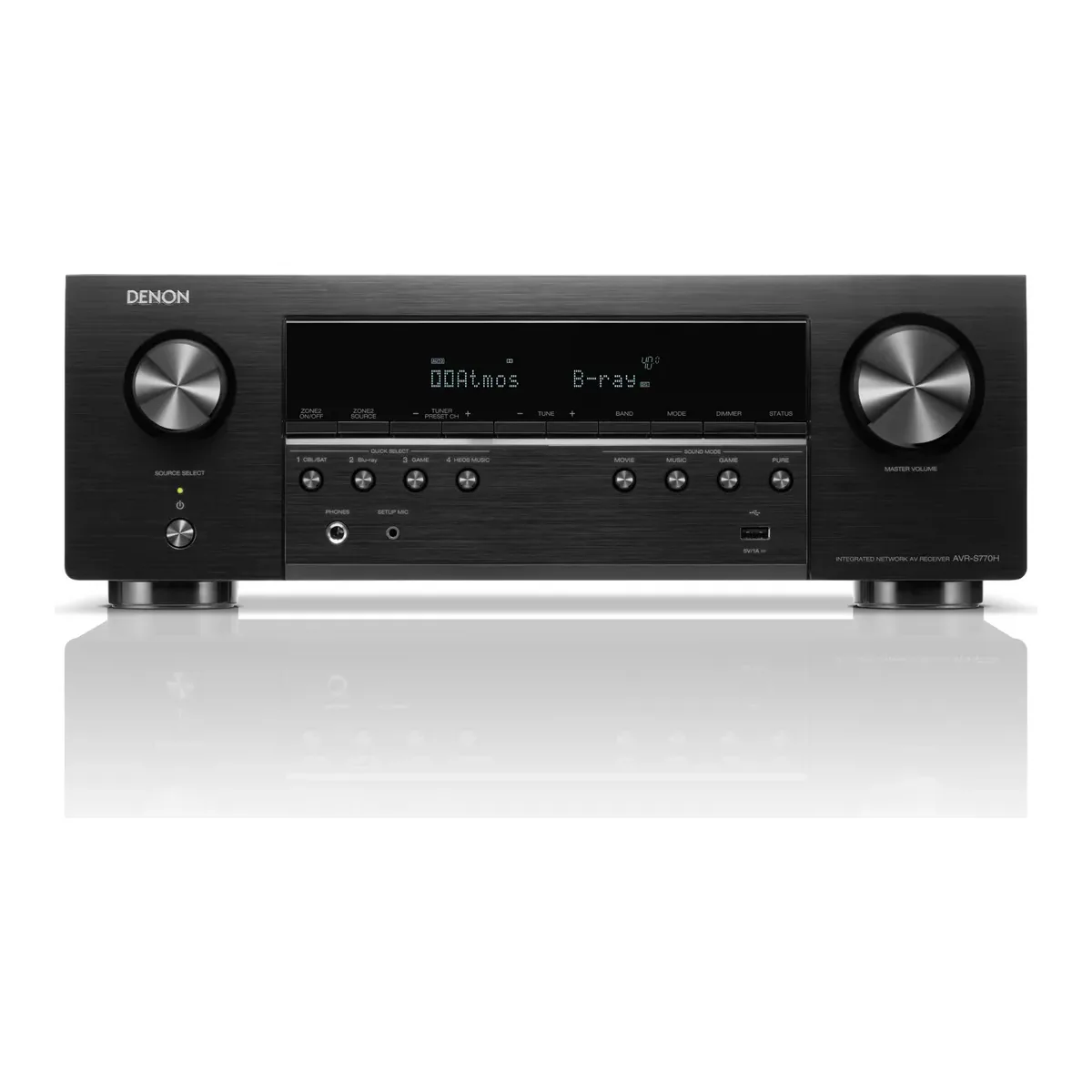
Seven amplifiers, a real phono stage and three 8K inputs at the far end of the row. Wire it wrong and nothing tells you, which is the only hard part of owning one.
- Seven power amps, 75W per channel at 8 ohms with two channels driven
- Dolby Atmos to a 5.1.2 layout, with Dolby height virtualization and DTS Virtual:X for setups without height speakers
- DTS:X, DTS Neural:X and DTS Virtual:X
- Six HDMI inputs, and 8K on the last three of them plus the output
- HEOS built in, AirPlay 2, Alexa and Google Assistant, Audyssey MultEQ
- Moving magnet phono input, two subwoofer outputs, 19 lbs
HDMI 4, 5 and 6. Those are the three connectors on the back of the Denon AVR-S770H that carry an 8K signal, and the socket Denon labels Blu-ray is not one of them.
That single fact decides more about how this receiver performs than its power rating does, because the penalty for getting it wrong is silent. A console plugged into the wrong port negotiates 4K, plays perfectly, and never once suggests the receiver is the reason it is not doing 120Hz. Denon's listing does say three of six. What no listing anywhere says is which three, and that is the only version of the fact you can act on. If you are still choosing between models, the rest of the shelf is ranked here, and the input question comes up on every one of them.
Everything below was read off Denon's own owner's manual, page by page, plus the info sheet and the live listing. Owner comments were counted too, though only about sixty of them sit on threads naming this receiver. No independent bench result for it turned up anywhere we looked, so where Denon says 75 watts, this page says rating and means it.
HDMI 4, 5 and 6, and what Denon labels them
The manual's Input Assign page prints the connector list exactly like this: "1 / 2 / 3 / 4(8K) / 5(8K) / 6(8K)". Three of the six are marked, three are not, and the same page gives the factory source assignment.
| Source label | HDMI connector | 8K |
|---|---|---|
| CBL/SAT | 1 | No |
| Media Player | 2 | No |
| Blu-ray | 3 | No |
| Game | 4 | Yes |
| AUX1 | 5 | Yes |
| AUX2 | 6 | Yes |
| TV Audio | none | n/a |
Read that column twice, because it is backwards from how anybody wires a rack. The connector named for a disc player runs at 4K. The two named AUX, the ones most people treat as spares for whatever is left over, are the good ones. Only Game lands where instinct would put it.
None of it is locked down, because Input Assign exists so you can move an 8K HDMI input onto almost any source name you please, and dragging Blu-ray over to connector 4 is a couple of screens in the setup menu. The one exception is TV Audio, which refuses an HDMI assignment while HDMI Control or ARC is on, and either of those is a switch anybody using the television as a source has thrown.
What nobody goes looking for is a setting, when the picture is already on screen and nothing is obviously broken. Cross shopping makes that worse rather than better: the Onkyo TX-NR6100 on the same shelf we measured puts its three 8K connectors at 1, 2 and 3. Opposite end of the row, same count, no convention to fall back on.
Turning on 8K is a menu setting, and it is per input
Plugging into connector 4 is half the job. The other half is a menu item called 4K/8K Signal Format, which offers Standard, Enhanced and 8K Enhanced, and Denon's instruction is unambiguous: "Set '4K/8K Signal Format' to '8K Enhanced' in the menu to enjoy 8K video." The box ships on Enhanced, one rung below, and 8K Enhanced is the rung 4K 120Hz needs as well as 8K. A console doing 120Hz on a factory-fresh receiver is on the wrong setting whichever port it is in.
It is set per input source, not once for the whole receiver. Denon's procedure opens with "Switch to the HDMI input source you want to set". Raise it for the console and the streamer plugged in beside it stays exactly where it was. Two devices, two trips through the menu. The display reports the setting for whichever input you have selected and never shows you all six at once, so the one you forgot stays forgotten.
Cable grade matters too, and Denon names a category rather than a brand. It asks for a certified Ultra High Speed HDMI cable, which is the HDMI 2.1 grade rated to 48Gbps. Anything below that is not a small compromise. Denon's troubleshooting section repeats the requirement with the consequence bolted on: "If you use a different HDMI cable, the video may not display or other problems may occur." Few manufacturers hand you the symptom before you have it.
Then comes a sentence manufacturers do not usually write. Denon says that at the 8K Enhanced setting, "video may not be output correctly depending on the connected playback device or HDMI cable", and tells you to step back down to Enhanced or Standard. Denon is documenting a failure mode in its own manual, which is unusual and honest. One more step goes with it and the section above does not: "configure the television or playback device settings to match this setting."
Nobody raises it in the sixty comments on this model's own threads. The shelf around it is another matter: across 326 owner comments about 4K 120Hz inputs failing, eleven people named the Xbox Series X or S and ten named firmware.
Mine stopped working when trying to connect using the 8k enhanced to do 4k at 120hz for the Xbox Series X.
That comment is from a thread about a rival brand and the writer never says what he owns. It is here because the sequence is the one Denon's manual warns about, not as evidence about this box.
Does 75 watts mean seven channels at 75 watts?
No. Denon's rating is two channels driven, from 20Hz to 20kHz, at 0.08 percent distortion into 8 ohms, and every channel pair in the specification carries the same figure measured the same way. Denon publishes two easier numbers beside it, 110 watts into 6 ohms and 165 watts into 6 ohms, both a single tone at 1kHz, the second at 10 percent distortion with one channel driven. To Denon's credit the listing and the product page both lead with the 75, which is the harder number and the one this page uses. Audioholics, previewing the model, described it as "75 watts of power per channel (in stereo mode, into 8-ohm speakers)".
That is not a criticism of the number. A full bandwidth rating at low distortion is the more honest of the two, and plenty of manufacturers lead with the easier one instead. What it is not is a promise about seven channels running at once. No measured result for this model turned up anywhere we looked, and we have not produced one either. So every watt figure on this page is a rating, quoted as one.
The speaker terminals accept 4 to 16 ohms, which covers essentially every home speaker you would put on this receiver.
Seven amplifiers, Atmos at 5.1.2, and where the other two go
Seven amps, and Dolby Atmos 5.1.2 is the ceiling. Those two numbers look like a shortfall until you add the second one up: five at ear level plus two overhead is seven. Immersive sound on this receiver uses every amplifier it has.
What you give up is the alternative arrangement. You can run 7.1 with surround back speakers, or you can run 5.1.2 with height speakers, and you cannot run both, because there are only seven amplifiers to go around. Without height speakers you get two virtualizers rather than one: Dolby Atmos Height Virtualization, which Denon says "creates the sensation of overhead sound even without a 5.1.2 system", and DTS Virtual:X, which the info sheet scopes to a 7.1, 5.1 or 2.1 setup. DTS:X and DTS Neural:X are both here too.
The two subwoofer outputs are the .2 in 7.2, and Denon writes that Atmos layout both ways in the same info sheet, 5.1.2 in one paragraph and 5.2.2 in another. Same speakers, counted with one subwoofer or two.
The moving magnet phono input is worth knowing about and worth not overrating. It is a real circuit: 2.5mV sensitivity, RIAA deviation inside plus or minus 1dB, 74dB signal to noise. What it does not do is separate this receiver from the shelf, because the Onkyo TX-NR6100 has one too, and publishes a better signal to noise figure on it while asking a hotter cartridge to drive it. It separates it from the cheaper AVR-S570BT, and that is all. If a turntable is the main event, the honest comparison is against a two channel amplifier rather than against another receiver.
Skip the Denon AVR-S770H if the television is the limit
Two settings ship off, HDMI Control and ARC, which catches people who run one cable to the television and hear nothing back. What rescues them is the television and not the receiver: Denon's wording is that an eARC compatible television "enables audio playback from the speaker connected to this unit, regardless of 'ARC' settings in the menu".
So a modern television works immediately. An older one needs ARC switched on here and HDMI Control, which your set may call CEC under some brand name, enabled over there. Denon is explicit that its own HDMI Control can stay off while ARC works, and eARC stops working entirely if you assign HDMI to the TV Audio source. Which cable should run back from the screen is its own question, and the answer lives on the television rather than on this box.
So skip it if the constraint is upstairs and the television is your source. On a set without eARC, audio coming back from the television is capped at conventional 5.1 or PCM, and no receiver changes that. A disc player or a console plugged straight into the receiver is unaffected, which is the distinction most pages in this category blur. Skip it too if you want surround back speakers and overhead speakers at the same time, or if you expect more than three 8K capable inputs, because both are amplifier and connector limits rather than firmware ones.
One question this page cannot settle. Two people in the video threads asked what actually separates the S series from the X series, one of them as "except the front buttons?". No X-series unit has been verified here, so it stays open rather than guessed at.
Will it fit the cabinet you already have?
Almost certainly on the shelf, and possibly not under the one above it. The receiver is 17.1 inches wide and 13.3 deep, which is standard, and 6.0 inches tall with the antenna folded down. Raise it and the unit needs 8.5. That two and a half inch difference is what turns a comfortable slot into a receiver operating with its antenna flat against a shelf, and Denon rates the unit for 41 to 95 degrees Fahrenheit, so a sealed cabinet is a worse idea than the numbers make it look.
It weighs 19 pounds and draws 400 watts flat out. The tenth of a watt Denon prints for standby carries a footnote worth reading, because it needs Network Control set to Off In Standby and HDMI Pass Through set to Off, and Pass Through ships on. Measure the vertical gap before it arrives. Everything else about living with this receiver is a menu you can reach from the couch.
Made up your mind?