Best AV Receiver for Home Theater: Four Verified Picks
Four receivers compared on channels, power and the 8K HDMI inputs count no listing prints. Which fits a small room, an Atmos room, or a turntable.
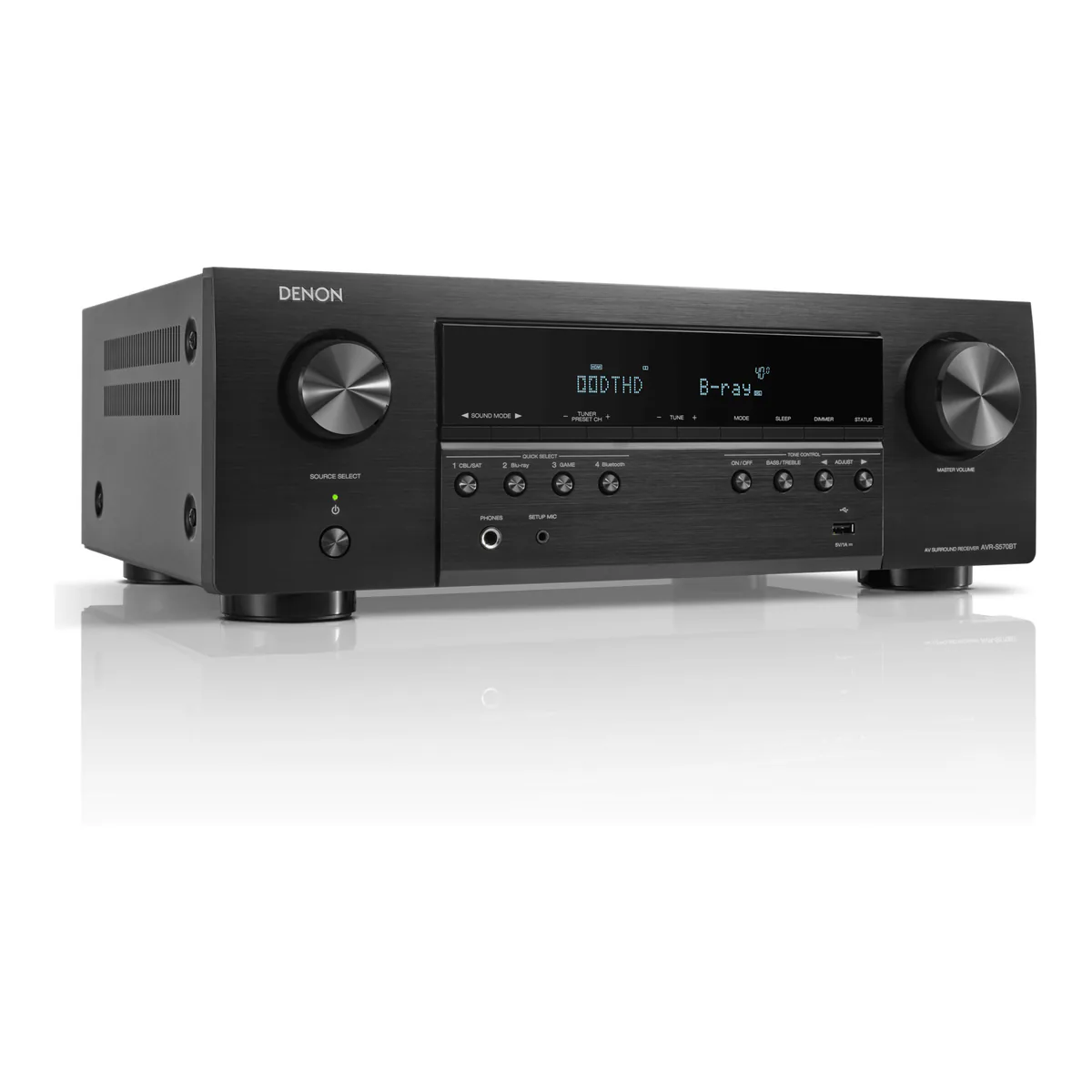
Five amps, four 8K inputs and no Atmos. The only receiver here where every HDMI port does what the box says.
- Five power amps, 70W per channel at 8 ohms with two channels driven
- Four HDMI inputs and one output, every one of them 8K/60 and 4K/120
- VRR, QFT and ALLM on all four inputs, HDCP 2.3, eARC on the output
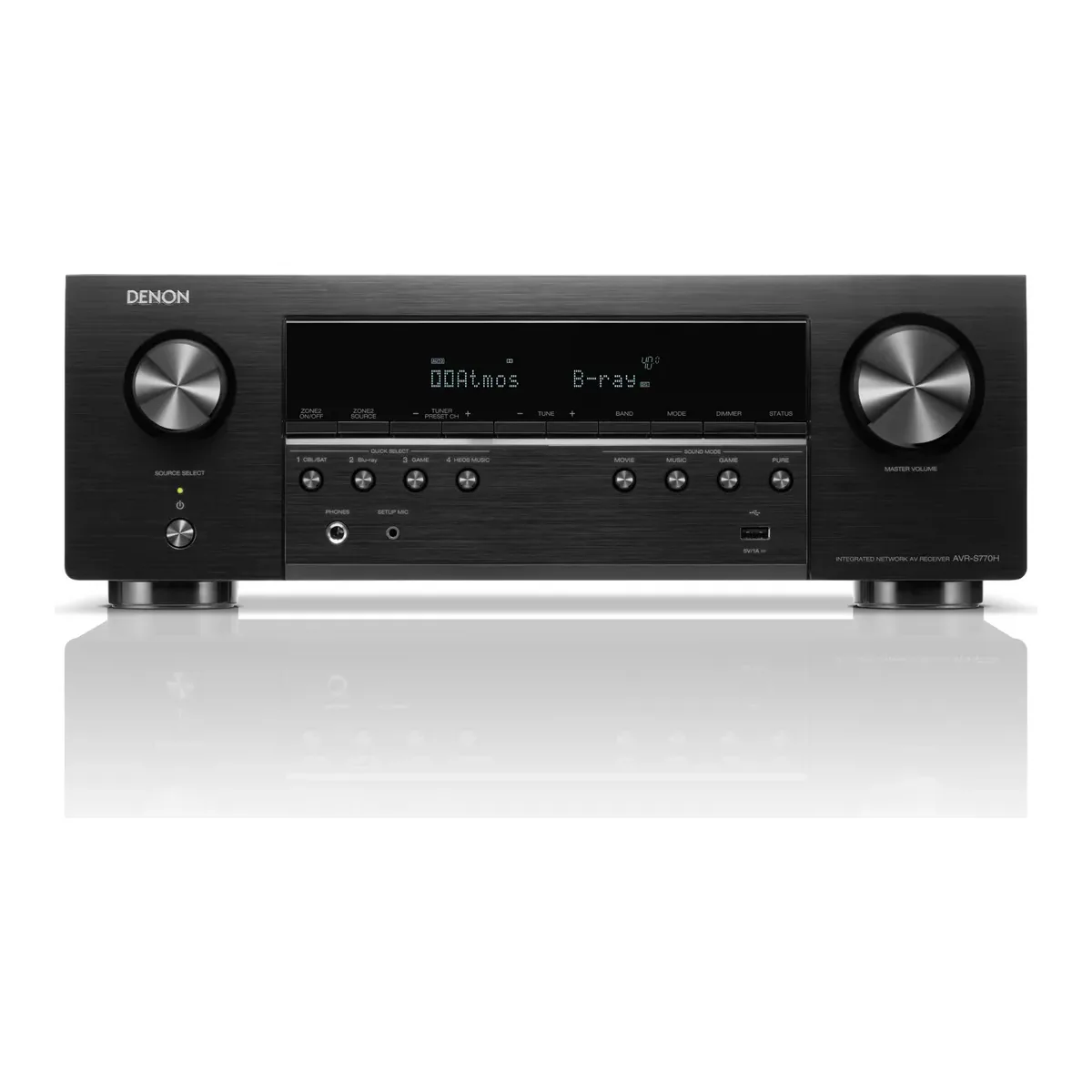
Atmos to 5.1.2, HEOS, a moving magnet phono stage, and 8K on three of its six inputs.
- Seven power amps, 75W per channel at 8 ohms with two channels driven
- Dolby Atmos to a 5.1.2 layout, with Dolby height virtualization and DTS Virtual:X for setups without height speakers
- DTS:X, DTS Neural:X and DTS Virtual:X
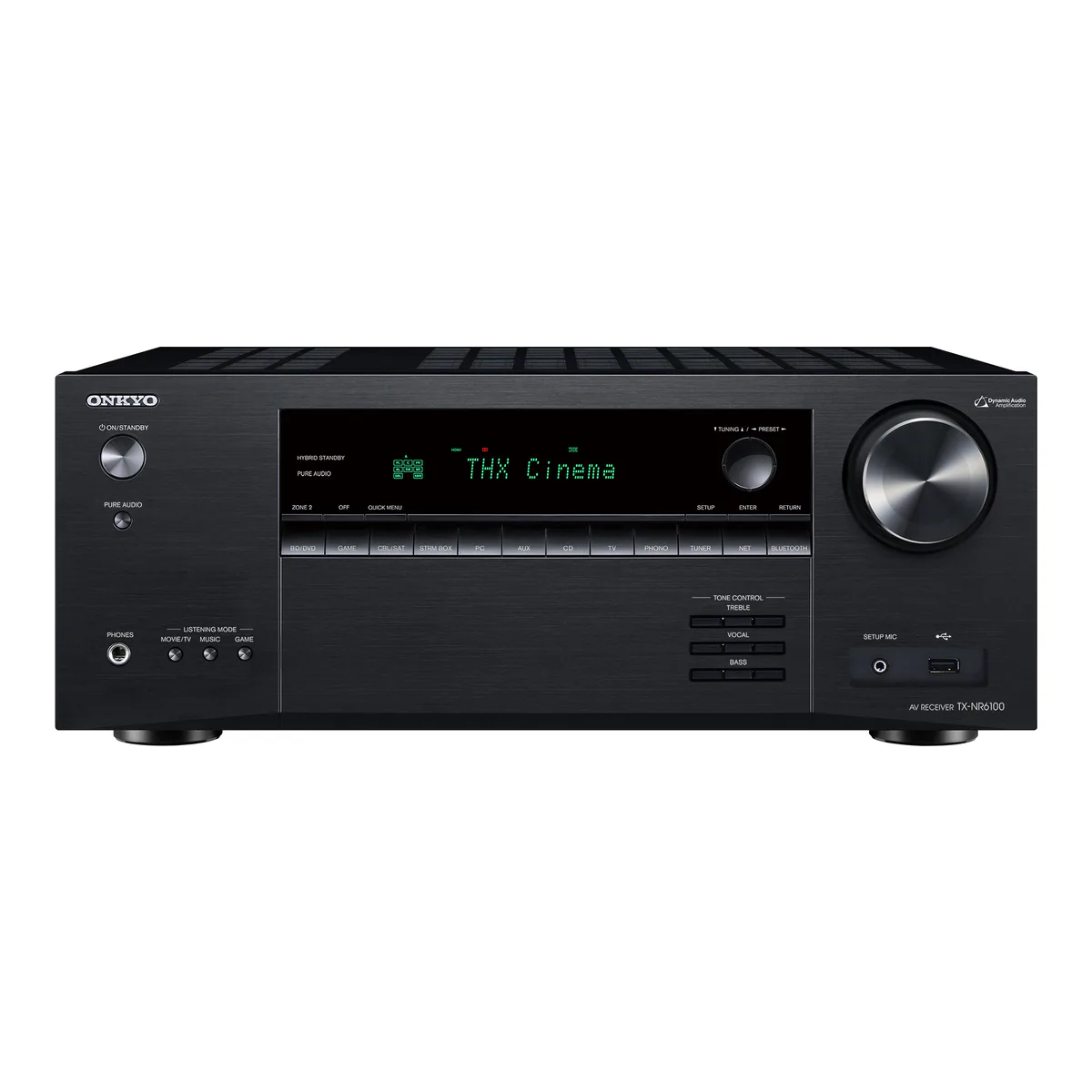
THX Select, two HDMI outputs and the widest network stack here, which is the combination a two-display room actually needs.
- THX Select certified, 7.2 channels, two HDMI outputs
- Rated 100W per channel at 8 ohms across the audible band with two channels driven; Onkyo also publishes 210W at 6 ohms, 1kHz, 10% with one channel
- THD 0.08% from 20Hz to 20kHz at half power, response 10Hz to 100kHz in Pure Audio

Two channels, a phono stage and no HDMI at all. Not an AV receiver, and frequently the right answer anyway.
- 90W per channel at 8 ohms across 20Hz to 20kHz at 0.09% THD
- 100W per channel at 8 ohms measured at 1kHz and 1% THD, which is the looser test
- Moving magnet phono input, four analog inputs, FM tuner with 30 presets
Three of six. That is how many of the Denon AVR-S770H's HDMI inputs actually carry 8K, and the Onkyo TX-NR6100 tells the same story on inputs one to three. Neither product page names which inputs, and neither does the row of features a shopper scrolls past.
So the first question when shopping an av receiver for home theater is not watts and it is not channel count. It is how many of the inputs do the thing the box advertises, because plugging a console into the wrong port gets you 4K, no error message, and nothing to suggest the receiver is the reason.
The strange part is that the AVR-S570BT, the smallest of the three HDMI receivers here, is the only one where all four of its inputs are 8K. Consistency is not what the tier above buys you. Channels and a network stack are.
What this ranking is built on
Four manufacturer specification pages, four live listings checked against Amazon's catalog, and four passes over the category's video threads returning 991 owner comments between them. Sony's page carries only its loose power rating, so the full band figure in the table below comes from Sony's own manual instead, read on a third party manual host that refuses automated checks, which is why that one figure is attested in our sourcing log rather than machine verified. That total is a sum across four searches that overlap, so treat it as the size of the reading rather than as a count of distinct people. Every count below names the single search it came from. Where a maker publishes the same specification measured two different ways, this page puts the strict one in the table, because the gap between the two is most of what a marketing number is doing. Denon publishes a loose rating on both of its receivers and Onkyo on its one, and the section below picks that apart on the pair where the gap is widest. Our full method is on how we pick.
The owner reports are the reason the 8K row leads the table rather than the power row. The complaint that recurs is not sound. It is a console, an HDMI 2.1 feature and a receiver in between: in one search of 326 owner comments about 4K 120Hz inputs failing, eleven people raised the Xbox Series X or S, eleven raised input lag and ten raised firmware updates. A different search, over Onkyo threads, turned up the clearest description of what that looks like.
Mine stopped working when trying to connect using the 8k enhanced to do 4k at 120hz for the Xbox Series X.
| Spec | Denon AVR-S570BT | Denon AVR-S770H | Onkyo TX-NR6100 | Sony STR-DH190 |
|---|---|---|---|---|
| Channels | 5.1, two sub outs | 7.2, Atmos to 5.1.2 | 7.2, Atmos to 5.1.2 | 2.0 |
| Power per channel | 70W, 8 ohm, 0.08% | 75W, 8 ohm, 0.08% | 100W, 8 ohm, 0.08% | 90W, 8 ohm, 0.09% |
| HDMI in/out | 4 / 1 | 6 / 1 | 6 / 2 | None |
| 8K inputs | All four | Three of six | Inputs 1 to 3 | None |
| Atmos / DTS:X | Neither | Both | Both | Neither |
| Network | Bluetooth only | HEOS, Wi-Fi, AirPlay 2 | Wi-Fi, AirPlay 2, Sonos via a Port | Bluetooth only |
| Phono | No | Yes | Yes | Yes |
The 8K input trap that no listing mentions
Read the 8K row before the power row. Denon publishes that three of the AVR-S770H's six inputs pass 8K; Onkyo publishes that the TX-NR6100 does it on inputs one to three and both outputs. Denon names its three only inside the owner's manual, and Onkyo's product page is the only place either brand puts the numbering where a shopper meets it.
The practical consequence is small and annoying. You have a console that wants 4K at 120Hz, a disc player, a streaming stick and maybe a PC. Three of those are indifferent. One is not, and it needs to live on a specific port you will find by trial and error unless you read the manual first.
That is not a hypothetical. Seven separate people in the Onkyo threads, counted in a different search from the numbers above, describe an HDMI path that simply stopped passing signal, and the quote above is one of them. The cluster mixes models, one of them a TX-NR686, so read it as something this shelf does rather than something one receiver does.
If your sources are a streaming stick and a cable box, none of this matters and you should ignore the whole paragraph.
The Denon AVR-S570BT is the small-room pick, and it is not an Atmos receiver
Denon's own technical table says five power amps. The name says 5.2, which counts two subwoofer outputs rather than two more channels, and the difference decides what this receiver can do. Five amps cannot drive a height layout, so there is no Dolby Atmos here and no DTS:X either. What you get is Dolby TrueHD and DTS-HD to a 5.1 room, done properly, at 70W per channel into 8 ohms across the full audio band at 0.08 percent distortion.
The video side is the surprise. All four 8K HDMI inputs carry 8K at 60Hz and 4K at 120Hz, with VRR, QFT and ALLM on every one of them, which is more consistent than either of the two receivers above it.
Skip it if you want height speakers, or you want to stream anything to it. There is no Wi-Fi, no Ethernet, no HEOS and no AirPlay. Bluetooth is the entire network story, and there is no phono input for a turntable. Which speakers it takes, and the menu default that holds every input at 4K 60Hz until you change it, are read out of its owner's manual separately.
Is the AVR-S770H the Dolby Atmos receiver you want?
For most rooms, yes, and the reason is the seventh amplifier rather than anything on the marketing page. Seven amps run a 5.1.2 layout, meaning five speakers at ear level, a subwoofer and two height channels, which is the smallest configuration where Atmos does something a good 5.1 setup does not already do. Denon also ships height virtualization for people who cannot mount anything, and it is a consolation prize rather than the real thing.
Everything else is the sensible tier above the AVR-S570BT: HEOS built in, AirPlay 2, Alexa and Google Assistant, Audyssey MultEQ room correction, a moving magnet phono input, and 75W per channel at the same honest 8 ohm measurement.
One number that is not on any listing and should be. The receiver is 6 inches tall with the antenna folded down and 8.5 inches with it up. Cabinet shoppers measure the first figure and then discover the second. Which three of its six inputs carry 8K, and what Denon labels them, is the question its own review answers.
Skip it if you need more than three 8K sources, or if a 5.1.2 ceiling is not enough and you were planning on 7.1.4. That is two tiers up, not one.
The Onkyo TX-NR6100 earns its THX certified receiver badge on connections
The interesting spec here is two HDMI outputs, and it is the only receiver on this page with a pair. A room with a projector for films and a television for everything else needs exactly that, and the alternative is an HDMI switch and a remote nobody can find. Each output carries 8K and 4K at 120Hz, with one asterisk in Onkyo's own footnote: feed the two of them from two separate HDMI sources and the ceiling drops to 4K at 120Hz.
The rest of the connection list is the widest on the page: Wi-Fi, Ethernet, AirPlay 2, Chromecast, Roon Tested, DTS Play-Fi, a moving magnet phono input and a Zone 2 line output. The Sonos badge needs reading twice: Onkyo's own footnote says a Sonos Port is required and sold separately.
THX Select certification sits on top of that, and it is worth being honest about how little we can tell you. THX has certified this receiver. What the program tests, and what passing it implies about how a receiver sounds, are questions only THX can answer, and thx.com returns 403 to us and to a headless browser alike.
The power figure is where this listing wants reading twice. Onkyo's headline is 210W, measured at 6 ohms, 1kHz, 10 percent distortion, with one channel driven. Denon publishes 165W for the AVR-S770H under exactly those conditions and chooses not to lead with it. On the same page Onkyo also gives the FTC number, 100W at 8 ohms across 20Hz to 20kHz at 0.08 percent with two channels driven, and that is the figure in the table above because it is measured the way Denon's 75W is. Like for like the Onkyo is stronger by roughly a quarter to a third. Set 210 against 75 and you get a factor of three that does not exist, and the two ratings are taken apart in its own review.
Skip it if your sources are all older, because three of its six inputs stop at 4K and 60Hz and you would be paying for a second output you have no display for. It also idles at 65W against the Denon's 29W. And check the seller line: this is the one pick here currently sold by a third party rather than by Amazon, and whether that seller ships it themselves or uses Amazon's fulfillment is not in the catalog data.
When the Sony STR-DH190 is the honest answer
Some people searching for a receiver want a turntable, two speakers and a volume knob. For them the whole category above is a tax, and a plain stereo receiver for a turntable is the correct purchase. We took that argument apart separately, because an amplifier answers most of what a receiver is asked to do once no HDMI cable is involved.
The STR-DH190 has a moving magnet phono stage, four analog inputs, an FM tuner with 30 presets, Bluetooth, a headphone jack and no HDMI whatsoever. Sony rates it at 90W per channel into 8 ohms across the full band at 0.09 percent, and at 100W per channel at 1kHz and 1 percent. Same receiver, two tests, and the bigger number is the looser one. That gap is the single most useful thing to understand before comparing any two receivers on this page.
Skip it if a television is ever going to be connected to it. There is no digital input of any kind, so a modern TV has to reach it over analog or Bluetooth. The two power ratings and what its phono stage takes are read off Sony's own manual in full.
How to choose an av receiver for home theater
Count your sources first, then count the inputs that do what those sources need. Everything else is easier than that step and most buyers do it last.
Channels come next, and the honest ladder is short. Five amps buys a 5.1 room. Seven buys 5.1.2, meaning Atmos with two height speakers. Nine buys 7.1.2 or 5.1.4. There is no clever way around the count, because each speaker needs an amplifier and receivers are priced by how many they contain.
Power ratings are the part designed to confuse you, so normalize them before comparing. A trustworthy rating names four things: impedance, frequency range, distortion, and how many channels were driven. A rating measured at 1kHz with one channel driven, accepting 10 percent distortion, will always look bigger than the same amplifier measured properly, and three of the four receivers here publish one. The difference is routinely a factor of two.
Then check the things that have nothing to do with sound. Does it fit the cabinet with the antenna up. Does it have a phono input if a turntable is coming. Does it need two HDMI outputs. Those decide satisfaction more often than the amplifier does, and they are all on the receiver shelf rather than in a listening test.
One connection decides more than any of those and it is not on the receiver at all. Every model here with HDMI carries eARC, on its output or, in the Onkyo's case, on its main output of two, so which cable brings sound back from the television comes down to what the set on the wall can do, not what you buy to sit under it.
What we check next
Yamaha's RX300A probably belongs on this page and is not on it, because every route to Yamaha's own specification page refused us. Retailer copy puts it in the AVR-S570BT's tier and calls it the RX-V385's successor, and retailer copy is not a manufacturer source, so nothing about it goes in the table until one answers.
The other open number is idle draw. The TX-NR6100 pulls 65W sitting there with no sound playing, which over a year is not nothing and which also makes a receiver a poor thing to hang off a battery during an outage. Denon publishes 29W and 39W for the AVR-S770H depending on its eco setting. Nobody publishes it for the Sony, and we will not print a figure we have not read.