Denon AVR-S570BT Review: 6 to 16 Ohms, 4K 60Hz by Default
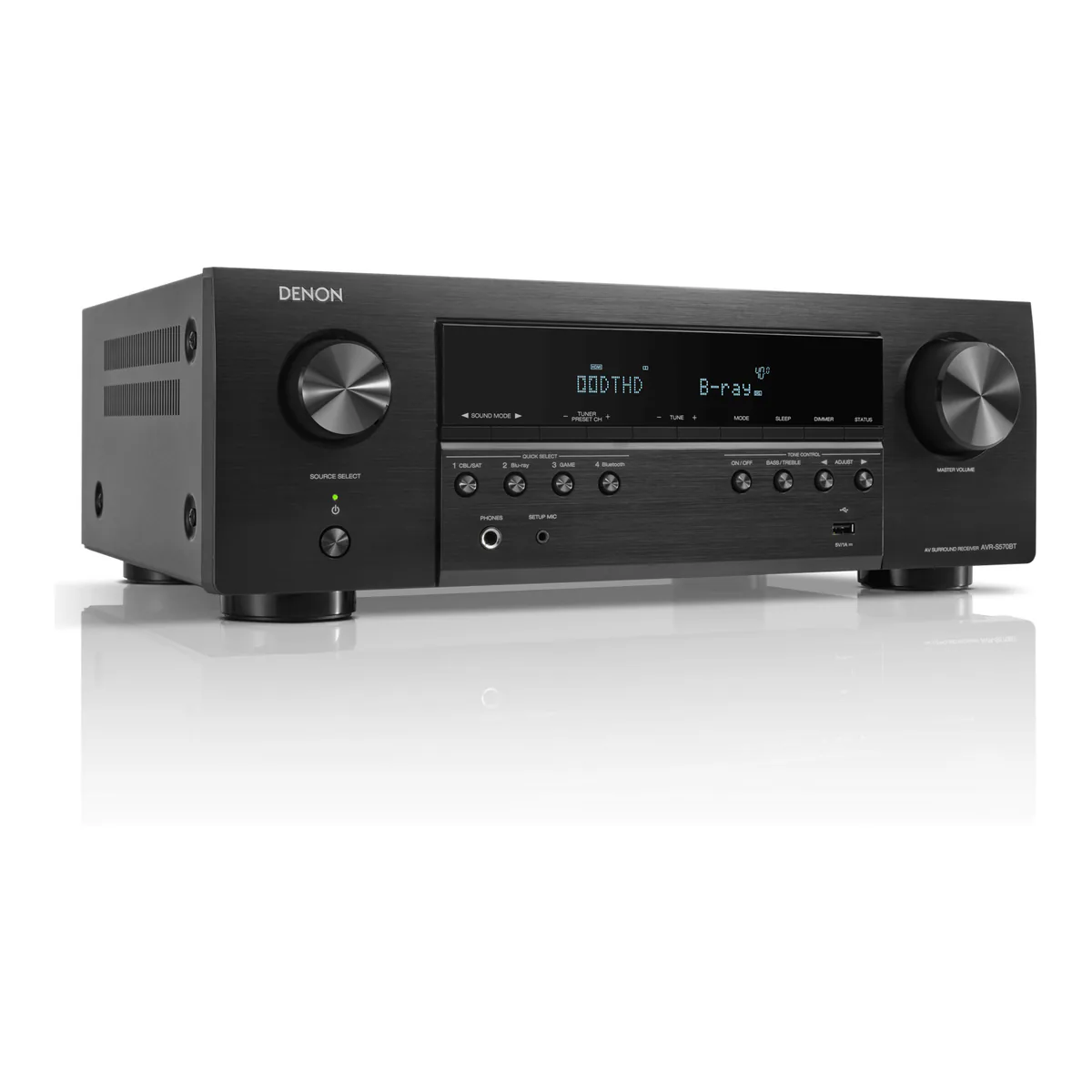
Five honest amplifiers, four 8K inputs, and the right receiver for a 5.1 room with one television. Buy it knowing 4K 120Hz is off until you turn it on for each input, and that 4 ohm speakers sit outside its rating.
- Five power amps, 70W per channel at 8 ohms with two channels driven
- Four HDMI inputs and one output, every one of them 8K/60 and 4K/120
- VRR, QFT and ALLM on all four inputs, HDCP 2.3, eARC on the output
- Dolby TrueHD and DTS-HD to 5.1. No Dolby Atmos and no DTS:X
- Bluetooth in. No Wi-Fi, no Ethernet, no HEOS, no AirPlay
- 16.8 lbs, 17.1 x 13 x 6 in
Any speaker rated between 6 and 16 ohms. That is Denon's answer to the question people type most often about the Denon AVR-S570BT, and it is a narrower answer than the AVR-S770H above it gives, because that receiver's manual says 4 to 16. If your speakers are 4 ohm towers, this is not your receiver. Anything else sold for a living room is inside the range, and 70 watts into 8 ohms is what each of the five channels is rated to give it.
Speakers and settings are what this page is for, because the specification sheet is already summarized on the shelf this receiver opens and the facts that decide whether you end up happy with it sit in the owner's manual instead. Twenty-five pages of that manual went into this review, with the info sheet, Denon's product page, B&H's listing and the live one. Owner comments were counted too: 334 across the category's video threads, 31 of them on threads naming this receiver, and no complaint among them recurred across two people.
So where this page says 70 watts, it means Denon's rating, and says so.
Which speakers work with the Denon AVR-S570BT
Denon's manual settles speaker impedance in one line under Before connecting speakers: use speakers rated 6 to 16 ohms, a range the Specifications page repeats for the output connectors. The AVR-S770H's specifications page gives 4 to 16, so impedance is one of the few points where the tier above buys compatibility rather than a feature.
Read the plate on the back of the speaker before the receiver arrives, not after.
Power is 70 watts per channel into 8 ohms from 20Hz to 20kHz at 0.08 percent distortion with two channels driven, and Denon prints that same figure for the front pair, the center and the surrounds. Into 6 ohms the rating is 90 watts at 1kHz and 0.7 percent. On the product page sits a 140 watt figure, one channel at 10 percent distortion, the same loose rating Denon prints for the AVR-S770H and Onkyo prints for the TX-NR6100, and not a number to compare anything against.
Small speakers change a setting, not the receiver. Crossover defaults to 80Hz and runs from 40Hz to 250Hz, and the manual's own example is a speaker that plays down to 250Hz, which gets its crossover set to 250Hz so the bass it cannot make goes to the subwoofer. Without a subwoofer the front pair is fixed to full band, so those two speakers have to produce the bass on their own.
The default that holds every input at 4K 60Hz
All four HDMI inputs carry 8K at 60Hz and 4K at 120Hz, and by default none of them does.
A menu Denon calls 4K/8K Signal Format is set for each input, and its default is Enhanced, the setting the manual describes for a television and source that support 4K 60Hz. One step above it is 8K Enhanced, for a television, a source and a cable that "support high quality 8K 60Hz or 4K 120Hz video signals", and you select it yourself, on the input the console is plugged into.
Nothing tells you. A console on an Enhanced input negotiates 4K 60Hz and plays perfectly, which is the same silent failure the AVR-S770H review found in that receiver's port layout, arriving here through a menu instead of a socket, and the better problem to have because the remote fixes it without anybody moving a cable. Denon adds two notes in the same paragraph: set the television or the source to match, and it recommends a certified Ultra High Speed HDMI cable. If the picture drops out on 8K Enhanced, the manual says to step back down.
Two more defaults belong on the same list. HDMI Control is off and ARC is off, so a television with ARC but not eARC sends no sound back down the HDMI cable until ARC is switched on here and HDMI Control is on at the television. An eARC television plays regardless of this receiver's ARC menu, though the manual says to check that eARC is switched on at the television too, and a television with neither returns nothing over HDMI and needs a separate audio cable. And the 8K upscaling the product page advertises is an HDMI Upscaler item whose default is Off, with HDR among the signals the manual says it never touches.
Five amplifiers, and what 5.1 means for the formats
Denon's own table gives the maximum number of processing channels as 5.1, and that figure explains the format list better than the 5.2 in the name does. Dolby TrueHD, Dolby Digital Plus and DTS-HD Master Audio decode. Dolby Atmos, Atmos height virtualization, DTS:X and Neural:X are each marked No. Two channel material is upmixed to five by Dolby Pro Logic II or DTS Neo:6, and over HDMI the receiver accepts 7.1-channel linear PCM, for which it has five speaker terminals.
The subwoofer count is real, with the same signal on both outputs, and it is the only pre-out on the back. The Multichannel Pre-Out row reads 0 (0.2), so there is no way to hand the front channels to a bigger amplifier later. What you buy is the whole system.
Room correction is a microphone at seated ear height, pointed at the ceiling, and a menu item Denon calls Room EQ: an on or off switch that appears only after that measurement and cannot be set while the sound mode is Direct or Pure Direct. Denon's specification table names no room correction vendor and lists Audyssey Dynamic EQ and Dynamic Volume as No. Change the speaker wiring or the subwoofer volume afterward and the manual says to run Auto Setup again.
Does the Denon AVR-S570BT stream music?
From a phone over Bluetooth. That is the complete list. The link is Bluetooth 4.2 with SBC and AAC codecs, rated to about 32.8 feet in line of sight, and it is a Bluetooth receiver and not a transmitter, so Bluetooth headphones cannot connect to it. There is no Wi-Fi, no Ethernet, no HEOS and no AirPlay 2. The front USB port plays FLAC, ALAC, WAV, MP3, WMA and AAC files from a drive at up to 24bit/192kHz.
Denon's product page muddles this. A paragraph headed high-resolution audio says you can "play files from USB and networked drives" and promises DSD playback, while the rear panel page of the manual lists nothing a network cable could plug into and the info sheet's USB format list has no DSD on it. Trust the specification table under that paragraph, not the paragraph.
One more Bluetooth limit, from one owner rather than a count. A reviewer on B&H bought this receiver to take a television's Bluetooth output and reported the sound running behind the picture. The receiver's Audio Delay runs from 0 to 200 ms and only ever delays the sound further, so it cannot pull a late Bluetooth stream back in line, and the reviewer adds that the setting is not offered on the Bluetooth input at all, which the manual neither confirms nor rules out. Television sound belongs on the HDMI cable, and whether that means ARC, eARC or optical is its own question.
Buy the AVR-S770H instead, or skip both
A 5.1 room with one television, speakers of 6 ohms or more, a console, a streaming box and a disc player on the four inputs, and music arriving from a phone: that room gets everything this receiver has, at 17.1 by 13 by 6 inches and 16.8 pounds, drawing 310 watts flat out. The 0.1 watt standby figure applies only with Bluetooth standby and HDMI pass through both switched off, and both ship switched on, so a phone that can wake it costs 1 watt all day.
Buy the AVR-S770H instead for height speakers, for a turntable, since this receiver has no phono input, for 4 ohm speakers, or for anything streamed over Wi-Fi. Buy neither if the room has a projector and a television, because that calls for a second HDMI output and only the Onkyo on this shelf has one.
And skip this one if you can picture adding an external amplifier in a few years. There is nowhere to connect it.
Made up your mind?