Onkyo TX-NR6100 Review: 210 Watts, or 100
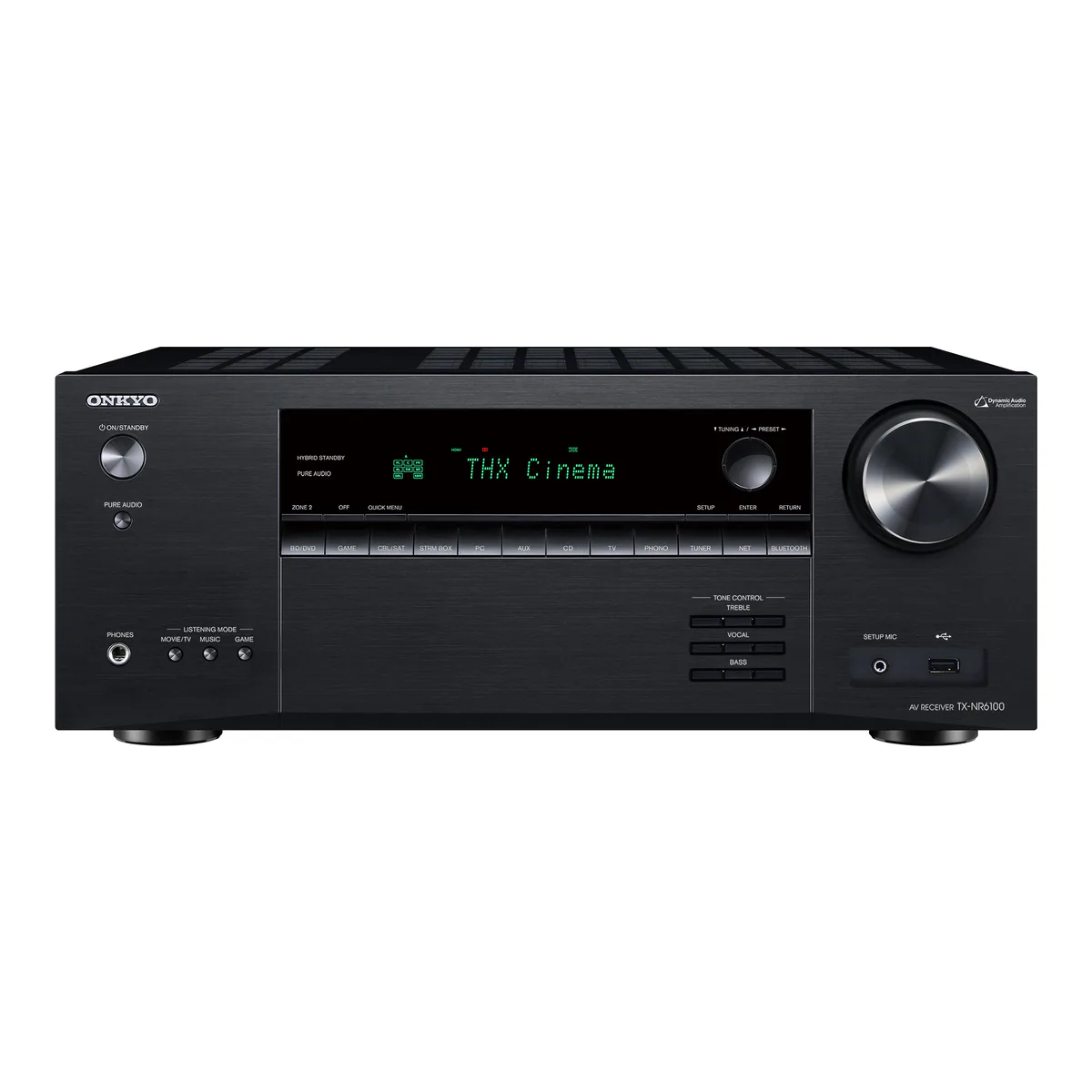
Two HDMI outputs, the only pair on our shelf, and the widest connection list on it. Sold on a power figure measured at 10 percent distortion, with the strict one printed beside it.
- THX Select certified, 7.2 channels, two HDMI outputs
- Rated 100W per channel at 8 ohms across the audible band with two channels driven; Onkyo also publishes 210W at 6 ohms, 1kHz, 10% with one channel
- THD 0.08% from 20Hz to 20kHz at half power, response 10Hz to 100kHz in Pure Audio
- HDMI inputs 1 to 3 and both outputs carry 8K/60p, 8K/30p and 4K/120p
- Wi-Fi, Ethernet, AirPlay 2, Chromecast, Roon Tested; Sonos needs a Sonos Port, sold separately
- Moving magnet phono in, AccuEQ room correction, Zone 2 line out, 21.7 lbs
Two hundred and ten watts per channel. That is the number Onkyo leads with on the Onkyo TX-NR6100, and printed beside it on the same line of the same specification table sits 100 watts per channel, which is the figure to carry into a comparison.
Neither is a lie. They measure different things, and the gap between them is most of what a power rating in this category is doing. Everything else on this receiver is more interesting than its watts anyway, starting with the fact that it has two HDMI outputs, the only pair on our shelf, and that the shelf it sits on is one where connection counts decide more than amplifiers do.
Read for this page: Onkyo's own US product page and its full specification table, the EMEA spec sheet, the live listing, and 428 owner comments of which 125 sit on threads naming this receiver, with no independent bench result turning up anywhere we looked.
210 watts on the box, 100 watts on the same page
Here is Onkyo's own line, unedited: "210 W/Ch (6 ohms, 1 kHz, 10% THD,1-ch driven) 100 W/Ch (8 ohms, 20 Hz-20 kHz, 0.08% THD, 2-ch driven, FTC)".
The first figure is a single channel, at a single frequency, into a 6 ohm load, accepting 10 percent distortion. Ten percent is audible, and it is the loosest of the ratings any of the four receivers on our shelf publishes. Denon runs the same one and publishes 165 watts for the AVR-S770H under identical conditions. The difference is not the test, it is which number each brand leads with.
The second Onkyo figure is the FTC method, both channels running across the whole audible band at 0.08 percent. The Denon AVR-S770H rates 75 watts the same way. So compare like with like and it reads 210 against 165, or 100 against 75, and either way the Onkyo is the stronger amplifier by roughly a quarter to a third. Set the loose headline against the strict number and you get a factor of three that does not exist. One caveat on the 100 watts, and it is the caveat the Denon page makes too: that is two channels driven, not seven. A 7.2 receiver with every channel working hard is not delivering 100 watts to each of them, and nobody in this category publishes what it does deliver.
Onkyo publishes a third set, labeled dynamic power. It reads 240 watts into 3 ohms, 210 into 4 and 120 into 8, front channels only. Onkyo does not define the measurement anywhere we could read, so take the label at face value and no further. What the shape shows is output climbing as impedance falls, which is what a hard to drive speaker asks of a power supply. Speaker terminals take 4 to 16 ohms.
Reading the input row, and what inputs 4 to 6 do
Onkyo puts this where a shopper actually meets it, which Denon does not. The US product page states it in a single line: "Inputs 1-3 and Main/Sub out support 8K/60AB and 4K/120AB. Inputs 4-6 support up to 4K/60 and HDMI 2.0 features."
Six inputs, three of them modern. Count the 8K HDMI inputs and you get three; the other three are not dead ports, they are 4K at 60Hz and HDMI 2.0, which is the correct home for a cable box, an older streamer or a Blu-ray player that will never send anything faster.
That is the opposite arrangement to the Denon beside it on the shelf we measured, which puts its three 8K inputs at connectors 4, 5 and 6.
Two brands, two conventions, no way to guess, and Denon does document its own mapping, in the owner's manual rather than on the product page. Onkyo extends the list to HDMI 2.1 generally, naming VRR, ALLM, QFT, DSC and QMS on inputs 1 to 3, the main output, and the second output while it is in Sub Mode. eARC is on the main output alone.
Two HDMI outputs, and the footnote under them
A receiver with two HDMI outputs is the reason to buy this one rather than something cheaper, and it is the only one of the four on our shelf that has them. A room with a projector for films and a television for everything else needs exactly that, and the alternative is an HDMI switch plus a remote that lives under a cushion.
Onkyo calls the second one Sub/Zone 2 Out, and that Zone 2 HDMI path does two different jobs depending on the mode it is in. In Sub Mode it carries the HDMI 2.1 feature set, and Onkyo lists the main and sub outputs together as the pair doing 8K. As Zone 2 it drives a second room from a different source, which is the trick the marketing copy sells.
The footnote is where the care is needed. Onkyo's own asterisk reads "8K60 only valid for Zone 1/Zone 2 will only produce 4K120 resolution when two separate HDMI sources are used", which is awkward enough to need a second pass. Run one source to both displays and 8K60 is available. Run two different sources to two displays and the ceiling drops to 4K at 120Hz. The wording is Onkyo's; the consequence is the same either way you parse it.
For almost everybody that is academic, because 8K content barely exists and a projector doing 4K at 120Hz is a better outcome than 8K at 60 anyway. It matters if you bought this receiver specifically to feed two 8K displays from two sources, which is the one use the footnote quietly rules out.
Does THX Select mean it sounds better?
No, and being precise about this is more useful than repeating the badge. A THX Select certified receiver is one THX has certified, and that is genuinely all this page can tell you. What the program measures, whether it yields a score or a pass, and what either says about how a receiver sounds are questions THX answers on its own site, which returns 403 to us and to a headless browser alike. We will not describe a test we have not read.
Onkyo's own page does not help, because the THX paragraph on the TX-NR6100's product page ends by describing the listening modes of the TX-NR7100, which is a different receiver a tier up, and which is a copy and paste error on the manufacturer's own site and the reason this page will not tell you how many THX modes the 6100 has.
One naming note while we are here. Onkyo writes the Atmos layout as 5.2.2, and Denon writes the same arrangement both ways inside a single info sheet, so this site uses 5.1.2 for both. Seven amplifiers, two subwoofer outputs, five speakers at ear level and two overhead, counted with one subwoofer or with two. What is verifiable sits in the specification table underneath. Distortion of 0.08 percent from 20Hz to 20kHz at half power. Frequency response from 10Hz to 100kHz within plus 1 and minus 3dB in Direct or Pure Audio. Signal to noise of 106dB on line inputs and 80dB on phono. Those are real numbers and they are good ones for the tier.
Skip the Onkyo TX-NR6100 if you want Amazon as the seller
The listing is sold by a third party rather than by Amazon directly, which the other three receivers on our shelf are not. Who ships it and who handles a return depends on whether that seller uses Amazon's own fulfillment, and the catalog data does not say either way. So read the seller line on the listing before you order. For a 21.7 pound box that plugs into everything you own, it is worth the ten seconds.
Skip it too if your source devices are all older. Three modern inputs is generous, and if none of your equipment does 4K at 120Hz then you are paying for connections you will not use and a second output you have no display for.
The one complaint that recurs is worth stating carefully. In this receiver's own threads two people describe the unit failing, one after a 4K 120Hz handshake and one with audio dying over time. A separate wider pass over Onkyo threads counted seven people describing an HDMI path that stopped working. At least one of those two is among the seven, and how far the sets overlap beyond that is not something the saved evidence can settle, so do not read nine. That cluster also mixes models: one of the seven names a TX-NR686, a different receiver. It supports this happening on Onkyo's shelf rather than on this unit.
Having the DVI audio issue which got worse over time until it stopped working.
What the second HDMI output is worth
Only what a second display is worth to you, and that is a narrower question than it sounds. A projector and a television in the same room qualifies. A television downstairs and a second one in a bedroom qualifies, though Zone 2 brings its own limits. A single television does not, and buying this instead of the Denon for a single television means paying for a socket you will never plug anything into.
Everything else here is the connection list, and it is the widest on our shelf: Wi-Fi, Ethernet, AirPlay 2, Chromecast, DTS Play-Fi, a moving magnet phono input at 3.5mV, and a Zone 2 line output. Read the Sonos badge carefully, though. Onkyo says the receiver joins a Sonos system "just by pairing it with a Sonos Port", and the footnote under it says "Sonos Port required and sold separately". It is the one item on that list that is a separate purchase rather than a saving.
It draws 635 watts flat out, 65 idling and a tenth of a watt in standby, and it is 17 and an eighth inches wide by 14 and fifteen sixteenths deep. Which cable carries sound back from the television is a separate question, and on this receiver eARC lives on the main output alone.
Made up your mind?